Advantages of RÊVE murals in interiors
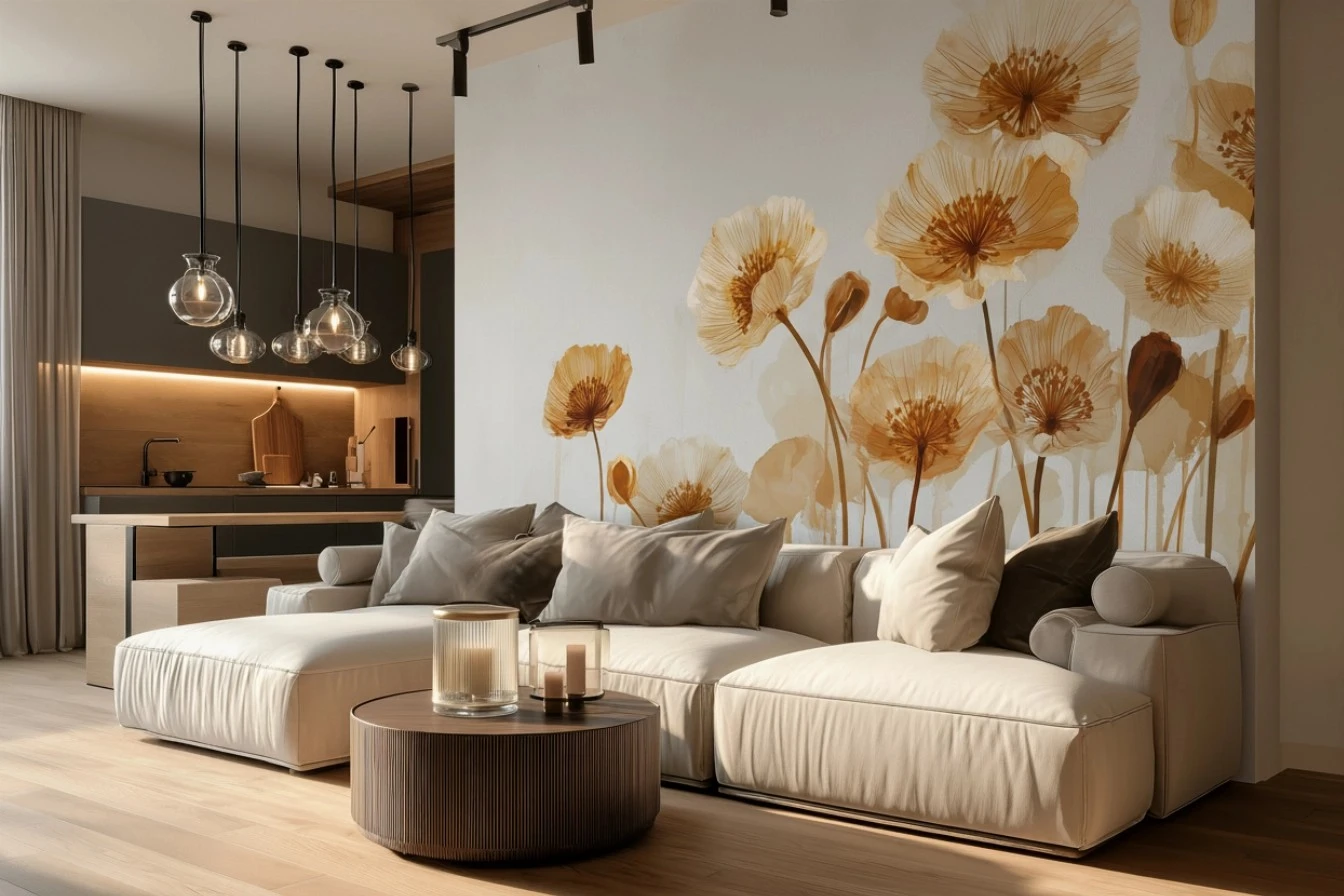
Advantages of RÊVE Murals in Private and Commercial Interiors
RÊVE murals help design a wall as part of the entire interior. They hide minor irregularities, mask microcracks, improve the perception of room proportions, and give the space a more refined character. They work well in homes, apartments, hotels, restaurants, offices, and public spaces.
Their advantage over ordinary paint is that they not only change the wall color. They introduce graphics, texture, rhythm, depth, and a chosen mood.
How does a mural hide wall irregularities?
A RÊVE mural can visually hide minor wall irregularities: gentle waves, abrasions, localized losses, traces of previous repairs, and uneven substrate patterns. It works best when the graphic has texture, soft tonal transitions, a plant, mineral, painterly, or abstract motif.
Uniform paint often emphasizes imperfections, especially with side lighting. The mural distracts attention and organizes the surface. The wall still requires preparation before installation, but the final effect is more visually forgiving than a smooth, single-color surface.
This is important in renovated apartments, apartments with large walls, and commercial spaces where surfaces are intensively used.
Does the mural mask cracks and scratches?
The mural can reduce the visibility of minor scratches, microcracks, and signs of use. It does not solve structural problems or active cracks but helps visually organize the wall if the imperfections are superficial.
Graphics with natural movement work well: lines, leaves, grasses, stone textures, water transitions, blurred landscapes, and soft abstractions. Such a pattern does not create a flat spot. It introduces depth, so minor marks on the wall do not dominate the interior's perception.
The mural is a good choice where the wall needs refreshing but not just another neutral color. Instead of hiding the problem with paint alone, you can give the surface a new function in the arrangement.
How does the mural change the character of the interior?
RÊVE murals can change the perception of a room with one wall. In the living room, they organize the relaxation area. In the bedroom, they create a calm background behind the bed. In the office, they warm up the workspace. In a hotel lobby, they are responsible for the first impression. In a restaurant, they build the atmosphere of the place.
This solution works especially well where the wall has a real role in the design. It is not an addition introduced at the end. It can connect the color of the floor, furniture, fabrics, stone, wood, ceramics, and lighting.
Thanks to this, the interior looks more cohesive. The mural does not compete with the furnishings but helps give them the right background.
Vertical lines, tall plant motifs, and compositions leading the eye upwards visually raise the wall. Light backgrounds and delicate tonal transitions brighten the room. Deeper, more saturated graphics can give a large space a cozier scale.
In a small room, the mural helps add depth without introducing many decorations. In a large living room, hall, or restaurant, it organizes an empty wall. In a corridor, it can guide the eye and give the interior a clear rhythm.
Therefore, choosing a mural should be combined with an analysis of light, room height, wall width, and furniture layout. The same pattern can work differently in a small bedroom and differently in a tall lobby.
How does the mural protect the wall?
RÊVE murals are available on vinyl substrates - gaining durability. This matters in places exposed to touch, dirt, and frequent contact with users.
Examples of such spaces are hallways, corridors, children's rooms, reception areas, hotels, restaurants, offices, and conference rooms. In these places, the wall is not just a background. It is a functional surface that works every day.
In public spaces, appropriate substrates and additional protections can be used. This way, the mural retains its decorative function while meeting the specific needs of the interior.
Can a mural replace wall decorations?
A mural can replace several separate decorations: a painting, poster, decorative panel, color accent, and background for furniture. One designed surface organizes the interior better than many random accessories.
This is important in premium projects where an excess of elements weakens the effect. The mural allows maintaining compositional clarity. The wall can be expressive but still calm and matched to the materials in the interior.
Mural instead of paint?
Paint changes the wall color. The mural changes its role in the design. It can hide minor imperfections, introduce depth, organize the zone, emphasize proportions, and give the interior a more individual character.
This difference is especially visible in spaces where the wall is large, empty, or difficult to arrange. The mural allows using this surface without heavy constructions, additional panels, and many separate decorations.
A well-chosen graphic does not act as an accessory. It becomes part of the interior architecture.
RÊVE Murals as a design choice
RÊVE murals combine decorative, functional, and design functions. They help hide minor irregularities, reduce the visibility of microcracks, protect the wall, improve room proportions, and give the space a clearer character.
Their strength is also personalization. The ability to crop, change scale, shift the pattern, and adjust colors allows preparing the mural for a specific wall, light, and interior layout.
At home, the mural can introduce calm and more refined detail. In a restaurant, it builds atmosphere. In a hotel lobby, it creates the first impression. In an office, it breaks neutrality. In each of these spaces, the wall ceases to be an empty surface and begins to work as part of the entire design.
